

Monitoring outer space is becoming increasingly important in the context of the growing number of satellites and the risks associated with space debris. An AI-based approach is proposed for detecting and analyzing space objects using optical instruments.
The main goal of this approach is the development of efficient methods for:
- accurate real-time detection of space objects
- use of data from optical instruments
- improving the accuracy of observations in challenging conditions
The system is designed to operate in real-world applications, with requirements for fast processing and high robustness.
The proposed methodology combines two complementary directions:
Machine learning models
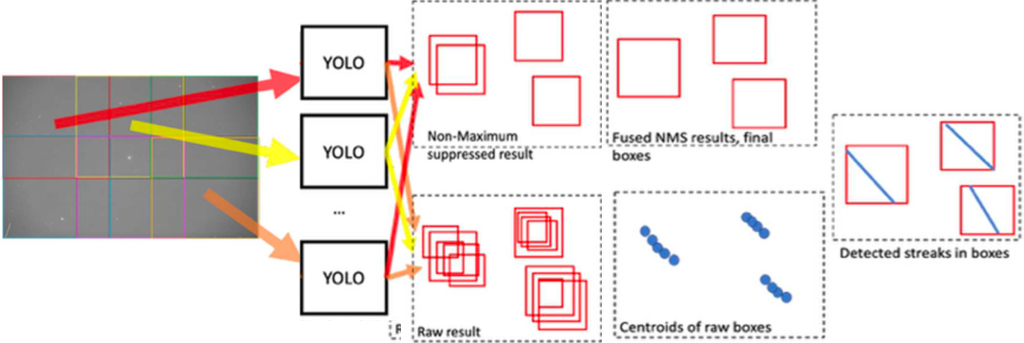
- use of YOLO models for object detection
- identification of satellite trajectories as “streaks” (light trails)
- direct processing of raw detector outputs to identify weak signals
Classical geometric models
- validation and refinement of detections obtained through ML
- improving localization accuracy
- reducing errors caused by noise or artifacts
This combination enables achieving a balance between data robustness and result accuracy.
Challenges
Detecting space objects from optical images involves a series of challenges:
- low signal-to-noise ratio (low SNR)
- interference caused by clouds and atmospheric conditions
- reduced visibility of objects (e.g., faint or distant satellites)
These aspects make it necessary to use advanced methods for data processing and filtering.
Results and contributions
The conducted research demonstrates the effectiveness of the proposed approach in detecting faint satellite trails, even under challenging conditions.
The contributions include:
- detection methods based on raw outputs of YOLO models
- integration of detection into a system capable of real-time operation
- detailed analysis of optical observations of satellites in low Earth orbit (LEO)