

The general objective of the project is the creation and operationalization of the Romanian Artificial Intelligence Hub (HRIA) for research, development, and innovation in the field of Artificial Intelligence (AI), through the development of an attractive and competitive research ecosystem that brings together efforts from the academic and economic environments, with the aim of producing original scientific research, transferring research results to industry and society, developing new products and services, and generating a core of knowledge and development in Artificial Intelligence integrated into the European Research Area (ERA).
The HRIA project will develop an ecosystem of excellence in Artificial Intelligence which, through its objectives and achieved results, will be unique in Romania in terms of the scope of research, development, and innovation activities and results with a tangible impact on the economy. HRIA will enable the consolidation of efforts within the Romanian artificial intelligence community in order to increase its impact at European and global level, becoming a catalyst for this process, creating national resources for development and innovation in the field of AI, and supporting all sectors of the community.

Figure 1. The excellence ecosystem created by HRIA
The HRIA project has the capacity to reach the critical mass of researchers and the necessary infrastructure to form a strong AI ecosystem, acting as an attractor and focal point for national efforts in the field of artificial intelligence, increasing the country’s scientific potential and developing market-ready artificial intelligence technologies usable across multiple sectors. The general objective and specific objectives (detailed in the following section) of the HRIA project were formulated based on a SWOT analysis of the AI situation in Romania, positioned in the European and global context, conducted over a period of more than 3 years.
The national distribution of the consortium, its previous achievements in AI, and its collaboration with SMEs will enable the dissemination and adoption of the Hub’s results across the entire country.
Thus, the consortium consists of seven universities: Project leader – National University of Science and Technology POLITEHNICA Bucharest (UPB), P1 – Technical University of Cluj-Napoca (UTCN), P2 – West University of Timișoara (UVT), P3 – “Gheorghe Asachi” Technical University of Iași (UTIasi), P4 – Politehnica University of Timișoara (UPT), P5 – University of Bucharest (UB), P6 – “Babeș-Bolyai” University of Cluj-Napoca (UBB), from four regions of Romania: Muntenia, Transylvania, Banat, and Moldova, and eight companies: P7 – Beia Consult International S.R.L. (BEIA), P8 – IT Center for Science and Technology S.R.L. (CITST), P9 – Greensoft S.R.L. (GREEN), P10 – Neural Grader S.R.L. (NEURAL), P11 – Safetech Innovations S.A. (SAFETECH), P12 – SoftTehnica S.R.L. (SOFTECH), P13 – Technology Systems and Services International S.R.L. (TECHSS), P14 – Terrasigna S.R.L. (TERRA).
The RDI topics, products, and services developed by these seven SMEs, selected following the call for proposals, significantly contribute to increasing the economic impact of the project. In addition, institutional and cooperation agreements with entities that have expressed their willingness to use the research results, both those already concluded (e.g., with DIHs) and those that will be established during the project, will also contribute to the creation of the HRIA excellence ecosystem.
The integration of HRIA and the Romanian artificial intelligence community into the European Research Area will be facilitated by institutional cooperation agreements with prestigious research entities (universities, research centers, and laboratories) across Europe.
The following research, development, and innovation directions (tracks/laboratories) have been identified within HRIA, which encompass the entire RDI activity of the project:
- T1: Trustworthy AI – methods and models for trust in machine learning (ML), computer vision, robotics, natural language processing, explainable AI;
- T2: Intelligent and autonomous systems – autonomous and connected mobility, assistive and social intelligent robots, autonomous navigation, intelligent control;
- T3: Human-computer intelligent interfaces – Interaction systems with understanding of written and spoken natural language, intelligent multimodal interfaces, AI at the boundary between the physical and virtual world;
- T4: Hardware technologies for AI – low-energy AI models, intelligent sensor networks;
- T5: AI in Medicine and Healthcare – Medical imaging, diagnostics, preventive and personalized medicine, active and assisted living;
- T6: AI in cybersecurity and space – intelligent applications for cybersecurity and space monitoring;
- T7: IA pentru orașe inteligente – Eficiență energetică inteligentă, soluții integrate pentru orașe inteligente, soluții pentru o viață sănătoasă;
- T8: AI for the environment – intelligent solutions for monitoring climate change, detecting, monitoring and preventing emergency situations, and analyzing images obtained from satellites and drones;
- T9: Development and testing of AI prototypes and systems – development of functional pilot projects, their application to various use cases, and testing and validation of AI systems and services.
The graphical summary presentation of these research directions can be seen in Figure 2.
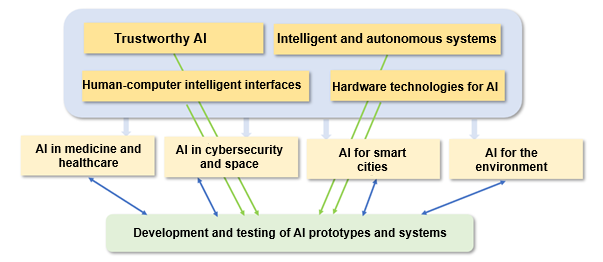
Figure 2. HRIA research, development, and innovation directions (according to the approved project fiche)
The HRIA project approach (Figure 3) is structured around four concepts, integrated into continuous feedback loops:
- Promoting research excellence (Foster research excellence): achieving and accelerating top-level research excellence in trustworthy AI, as well as developing and implementing AI systems based on the obtained results
- Boosting innovation and technological transfer (Boost innovation and technological transfer): achieving a high level of innovation, knowledge and technology transfer, facilitating the development of artificial intelligence-based products and services
- Increasing economic competitiveness (Increase economic competitiveness): leveraging the project’s results for sustainable growth in Romania’s economic competitiveness
- Stimulating cooperation (Stimulate cooperation): developing and maintaining a vibrant national cooperation network in the field of AI, facilitated by the synergy between academia and industry and by the involvement of all stakeholders around RDI topics and identified needs.
Figure 3. HRIA approach