
The research focuses on identifying AI-based solutions and Digital Twin concepts to address complex forecasting challenges in distributed energy networks (Smart Grids).
Forecasting Challenges and Digital Twin Architecture
- Data Complexity: Energy forecasting is challenged by the stochastic nature of weather and human behavior, non-stationary consumption patterns, and limited data from lower-quality sensors.
- Business Impact: Prediction errors lead to imbalance penalties, incorrect market bids, and energy waste.
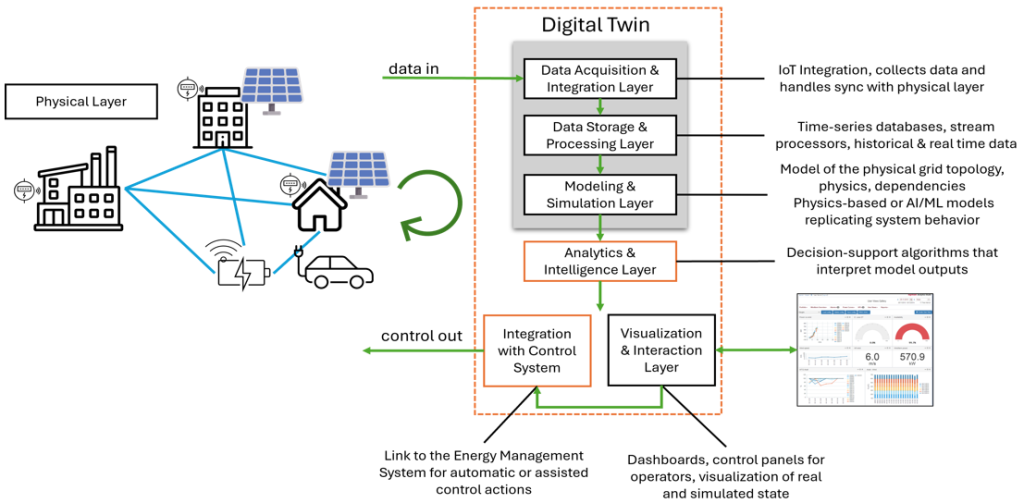
- Multi-Layer Solution: The proposed architecture includes IoT data acquisition, storage in time-series databases, simulation of system behavior using physical or AI/ML models, and direct integration with an Energy Management System (EMS) for automated control.
Representation-Augmented Temporal Fusion Transformer (TFT) Architecture
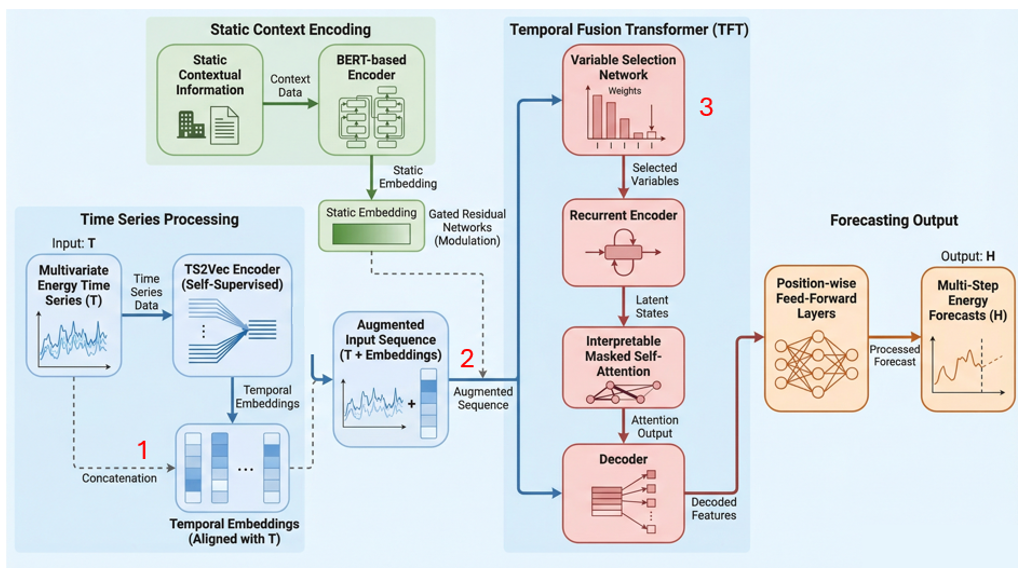
This hybrid approach learns stabilized temporal representations that are conditioned on structural information, providing interpretable forecasting.
- Temporal Pattern Extraction: Uses a self-supervised encoder (TS2Vec) to transform raw energy signals into coherent representations, mitigating noise and data sparsity.
- Structural Context Conditioning: Asset-specific structural information (text-based) is processed using a BERT-type encoder and injected into the temporal representations to capture asset-specific dynamics.
- Interpretable Forecasting: The model dynamically selects relevant covariates at each step through a variable selection network and uses an “Interpretable Masked Self-Attention” mechanism to provide interpretability for its decisions.
Concept of “Agentic Digital Twin”
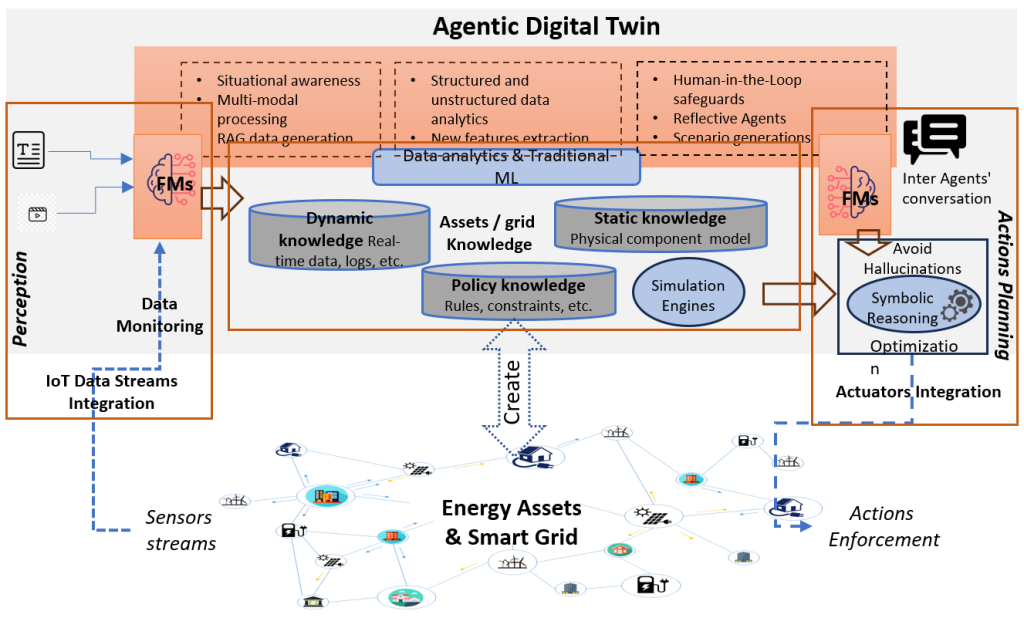
It represents a next-generation model that integrates foundation models to bring proactivity, autonomy, and multimodal situational awareness into energy management systems.
- Perception and Analytical Processing: Uses Retrieval-Augmented Generation (RAG) for data generation and extracts features from both structured and unstructured data.
- Knowledge Bases: The system integrates dynamic knowledge (real-time data, logs), static knowledge (models of physical components), and policies (rules, constraints).
- Action Planning and Reasoning: Reflective agents communicate with each other (inter-agent conversation) and generate scenarios. Symbolic reasoning is used to avoid system hallucinations and to implement optimizations, with safety mechanisms such as “Human-in-the-Loop”.