

Agentic AI: Video Segmentation for Polyp Detection (Gastro Clinic)
The implementation aims to optimize polyp detection through real-time video segmentation, using a colonoscopic agent based on state-of-the-art (SOTA) architectures.
Architecture and Methodology
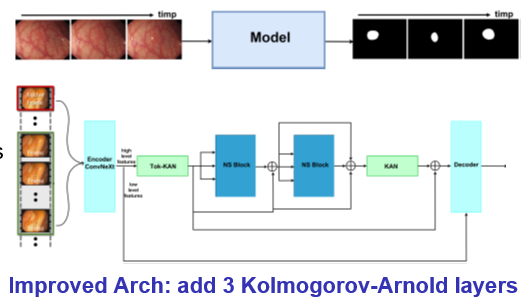
- Backbone: ConvNeXt is used, a CNN-based architecture (ResNet) but improved with Transformer-specific design principles.
- Feature Extraction: The model is structured into 4 stages; the last two provide low-level features (H/8 x W/8) and high-level features (H/16 x W/16).
- KAN Innovation: The architecture was enhanced by adding 3 Kolmogorov-Arnold (KAN) layers.
- KAN Layer Configuration: A KAN layer is defined as a matrix of activation functions and uses depth-wise convolutions.
- Training: The ConvNeXt backbone weights were obtained through pre-training on the ImageNet-22K dataset.
Performance and Validation
- Dataset: The evaluation was performed on SUN-SEG, the largest fully annotated colonoscopic sequence dataset, using 19,544 images containing polyps and their corresponding masks.
- Reference metrics (Dice SOTA): Cross-Attention-based models use PNS+ (73.7%), SALI (82.2%), and YOLO-SAM2 (90.2%) as benchmarks.
- Proposed Model Results: It outperforms PNS+ on every metric for both difficulty levels of the dataset.
- Computational Efficiency: The model maintains a processing speed above 10 FPS, reaching an average of 12.91 FPS.
Automatic Invoice Management & Resident Support System
The system integrates administrative document processing and academic support through neuro-symbolic methods and ontologies..
Automated Invoice Management
- Data ingestion: Invoices are automatically downloaded from SPV (Private Virtual Space) and processed into a knowledge graph aligned with the system ontology.
- Ontological Capabilities: The integration of product and invoice ontologies enables update suggestions based on invoiced content.
- GRN Automation: Automatic generation of Goods Receipt Notes (GRN) based on history and product characteristics from the ontology.
Resident Support System
- Neuro-Symbolic Approach: File classification and annotation use the ontology as a foundation, while the actual classification is performed using a neural approach.
- Query: The search function is implemented through SPARQL queries over the system ontology.
- Development Status: The complexity of the ontology is being analyzed and the appropriate reasoning engine is being selected (GraphDB, Stardog, or more expressive solutions).
Feedback-Driven Agentic LLM for Autonomous Research
The multi-agent architecture is designed for structured academic workflows and autonomous research..
Workflow (Pipeline)
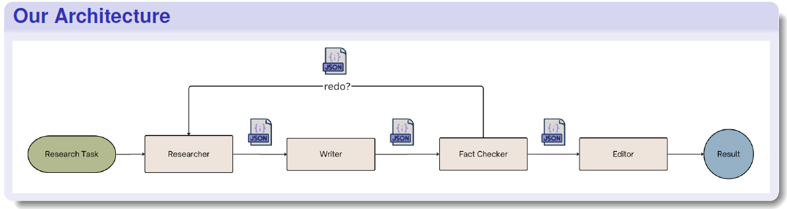
The system uses JSON contracts for communication between agents and includes editorial-style revision loops:
- Researcher: Receives the research task and collects the data.
- Writer: Produces the content based on the research.
- Fact Checker: Performs claim validation and ensures claim-level evidence traceability.
- Editor: Refines the final output; may request a redo if quality criteria are not met.
Technical Objectives
- Reproducible Reasoning: Documentation of the reasoning process to ensure reproducibility.
- Final Output: Generation of a one-page summary, including the list of references and the corresponding citations for the analyzed topic.